New Home Construction in Port Lavaca, TX
Your house has to earn its windstorm certificate while it goes up
Maybe you already own the lot. Maybe you are still looking. Either way, Calhoun County is one of the fourteen Texas counties where a new house needs a state windstorm inspection, and the inspector has to see the straps and the nailing before drywall covers them.
NTEX Construction builds single-family homes in Port Lavaca and across Calhoun County, out of our shop 46 miles northwest in Goliad, where we also work as a custom home builder. Family owned and operated, so an owner answers the phone and an owner runs your job. Call (361) 645-4000 and tell us about your lot.
What we build in Port Lavaca
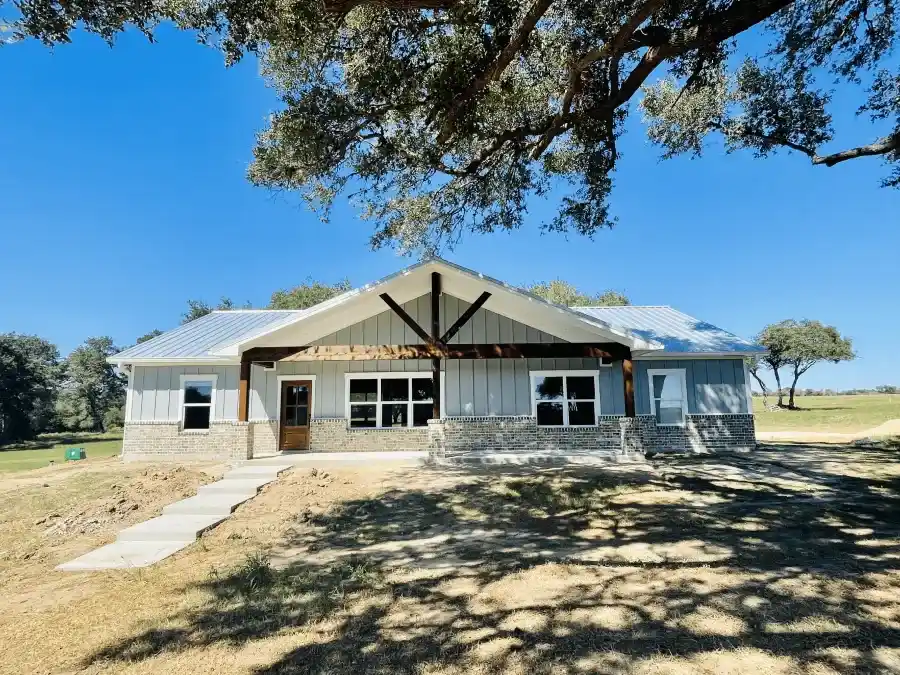
We build one thing very well: a single-family home, made for the people living in it. If the house already stands and you want it changed, that is home remodeling in Port Lavaca, which runs on a different set of steps.
Build on your own land
Start from your plan or ours
Pick your own finishes
The windstorm certificate is what gets you insured
Calhoun County sits inside the state windstorm catastrophe area. A new house here needs a Certificate of Compliance from the Texas Department of Insurance, the WPI-8, before most carriers will write wind and hail coverage on it.
The WPI-1 application goes in before construction starts, and an inspector comes back at each new phase. Straps, anchors, sheathing, and nailing patterns get covered up and nobody sees them again, so they get looked at while they are still open. A Department inspector or a Texas licensed engineer appointed by the Department signs off, and the certificate posts to the state site about three working days later.
Since April 1, 2026, those applications have to be certified to the 2024 residential and building codes. We file the paperwork, call the inspections, and build to the code the certificate requires.
Hurricane Carla came ashore near Port O’Connor on September 11, 1961, a strong category four, and the eye tracked straight across Port Lavaca. Storms in 1914 and 1919 hit the town hard enough that it built a seawall in 1920.

Loam on top, cracking clay underneath, water two feet down
The ground around Port Lavaca is flat and drains poorly. A loam surface sits over a clayey subsoil that cracks when it dries out.
The Matagorda series was described in Calhoun County, in rangeland about thirteen miles southeast of town near Indianola. Very fine sandy loam on top, very slow permeability below, and through the cool season the profile stays saturated within two feet of the surface. Some of it carries enough salt to matter once you start landscaping.
Clay that swells and shrinks moves a slab, and a water table that close to grade changes how the pad gets built and where water goes after a hard rain. A slab detail that works on the heavy clay up in Victoria County gets redrawn for this ground.
We start with the dirt. Soil work first, a slab engineered for what that ground actually does, and a pad and grading plan that gets water away from the house instead of letting it sit.
City code, county rules, and the flood map
Inside the city limits, plans go to Development Services at 202 North Virginia, phone 361-552-9793. The city ordinance adopts the 2015 residential and building codes and points its wind provisions at the 2018 building code, while the state windstorm program now certifies to the 2024 editions. We build to whichever is stricter on any given detail, because the certificate depends on it.
Out on county land, Calhoun County handles the floodplain development permit and the septic system as the authorized agent for the state environmental agency. The town is mapped under NFIP community 480097 on the map effective August 2, 2018, and there are both AE and VE zones around town. On a lot in either one, the county wants a survey of the natural ground elevation attached to the development permit, the lowest floor at or above the base flood elevation, and a finished construction elevation certificate filed with the floodplain office within sixty days of completion. That office is at 211 S. Ann Street, Suite 301.
Septic on a tract of ten acres or more may be exempt from permitting, but only if all four conditions hold: the system creates no nuisance or pollution, every part of it sits at least a hundred feet from the property line, the effluent stays on your property, and the house is the only dwelling on the tract. The system still has to meet state construction standards either way. We will tell you which side of that line your lot falls on.
You sign where we point. We do the rest.

How your build runs
We sit down
We draw it
We price it
We file the windstorm paperwork
We handle the rest of the permits
We pour
We build and call the inspections
We finish it and walk it with you
What a new home costs here
- Where your lot sits on the flood map. An AE or VE zone means a survey, a minimum floor elevation, and usually fill.
- Utilities. City water and sewer at the curb is one price. A septic system and a well is another.
- Windstorm construction. Straps, anchors, tighter nailing, and rated windows and doors all cost more than they would forty miles inland.
- Square footage, and how it is shaped. A simple rectangle costs less per foot than a house with six corners.
- One story or two.
- Finishes. This is the swing. The same floor plan can land at two different numbers.

Testimonials
What Our Neighbors Say
I love working with everyone at NTEX. They do quality work, are very timely, and fun to work with!
Ready to build in Port Lavaca?
Frequently Asked Questions
How long does it take to build a new home in Port Lavaca?
What is a WPI-8 and do I actually need one?
Do I have to own the land before I call?
Who pulls the permits?
What does the flood zone change about my house?
Can I use my own house plans?
What about water and septic on a county lot?
NTEX Construction
Let’s Talk About Your Custom Home Project
Connect With Us
Whether you have questions, would like a quote, or are ready to start your project, submit the form or call us at (361) 317-7385 to get in contact with us.